Async/Await: Suspension & Microtasks
Async functions in Node.js always give the caller a promise. That part is easy to remember. The part that trips people up is timing.
When you call an async function, the body starts running immediately. V8 creates the promise that will be returned to the caller, then runs the function body like normal JavaScript until it reaches an await, a return, or an error that leaves the function.
Once the function hits await, V8 saves where the function stopped. The rest of the function gets scheduled to continue later. That "later" work runs through the same promise-job system used by .then() handlers.
V8 handles the async function state - the saved locals, the resume position, and the promise returned to the caller. Node decides where those promise jobs run relative to process.nextTick(), timers, I/O callbacks, and the rest of the event loop.
The snippets below use plain JavaScript unless a block says otherwise. Short examples with top-level await assume an ES module or an enclosing async function. Names such as db, fetchUser, and transform stand for functions from your own application. When CommonJS and ES modules schedule things differently, the text calls that out.
How async/await Works
Async/await makes asynchronous code read like direct step-by-step control flow. Underneath, the work still moves through promises.
Code before the first await runs immediately. Code after await runs later. Errors thrown inside an async function become promise rejections unless your code catches them inside the function.
Adding async changes the function's contract right away. Call the function and you get a promise every time. The body can return a number, throw an error, perform several awaits, or finish without a return statement. The caller still receives the promise created when the function started.
That promise-returning contract is where a lot of small bugs begin. If you pass an async callback to Array.map(), you get an array of promises. If you pass an async comparator to Array.sort(), sort() receives a promise where it expects a number. The problem comes from giving a promise-returning function to an API that expects a synchronous result.
Here is the smallest version of the rule -
async function getNumber() {
  return 42;
}

const result = getNumber();
console.log(result instanceof Promise);
The log prints true. The 42 becomes the fulfillment value of the promise returned from getNumber().
A missing return fulfills the promise with undefined. A thrown error rejects that same returned promise -
async function boom() {
  throw new Error("broken");
}

boom().catch(e => console.log(e.message));
The throw happens while boom() is being called. The async function wrapper catches that error and rejects the promise it already returned. The caller handles it with normal promise handling.
Returning another promise works through adoption. The async function still returns its own outer promise, but that outer promise follows the promise returned from the body. If the inner promise fulfills, the outer promise fulfills with the same value. If the inner promise rejects, the outer promise rejects with the same reason.
Thenables go through the usual thenable assimilation path, covered in the previous subchapter. Native promises are heavily optimized in modern V8, including the V8 version shipped with Node v24, but the user-facing rule stays the same - callers observe the async function's returned promise.
One return detail is worth being clear about because it changes error handling.
return somePromise forwards the promise through the async function's resolution path. return await somePromise waits inside the current function, then resolves the outer promise with the fulfilled value.
Use return await when the current function needs to catch, wrap, log, or clean up around that promise. Direct return is fine when the function is only forwarding the promise.
await Suspends One Function
await pauses the current async function. Other JavaScript that is ready to run keeps going.
async function example() {
  console.log("A");
  const val = await Promise.resolve("B");
  console.log(val);
  console.log("C");
}

example();
console.log("D");
Output -
A
D
B
C
The first log runs immediately. When V8 reaches await, it saves the function state and gives control back to the caller. The caller prints D. Later, during promise microtask processing, V8 resumes the async function with the fulfilled value "B" and runs the remaining logs.
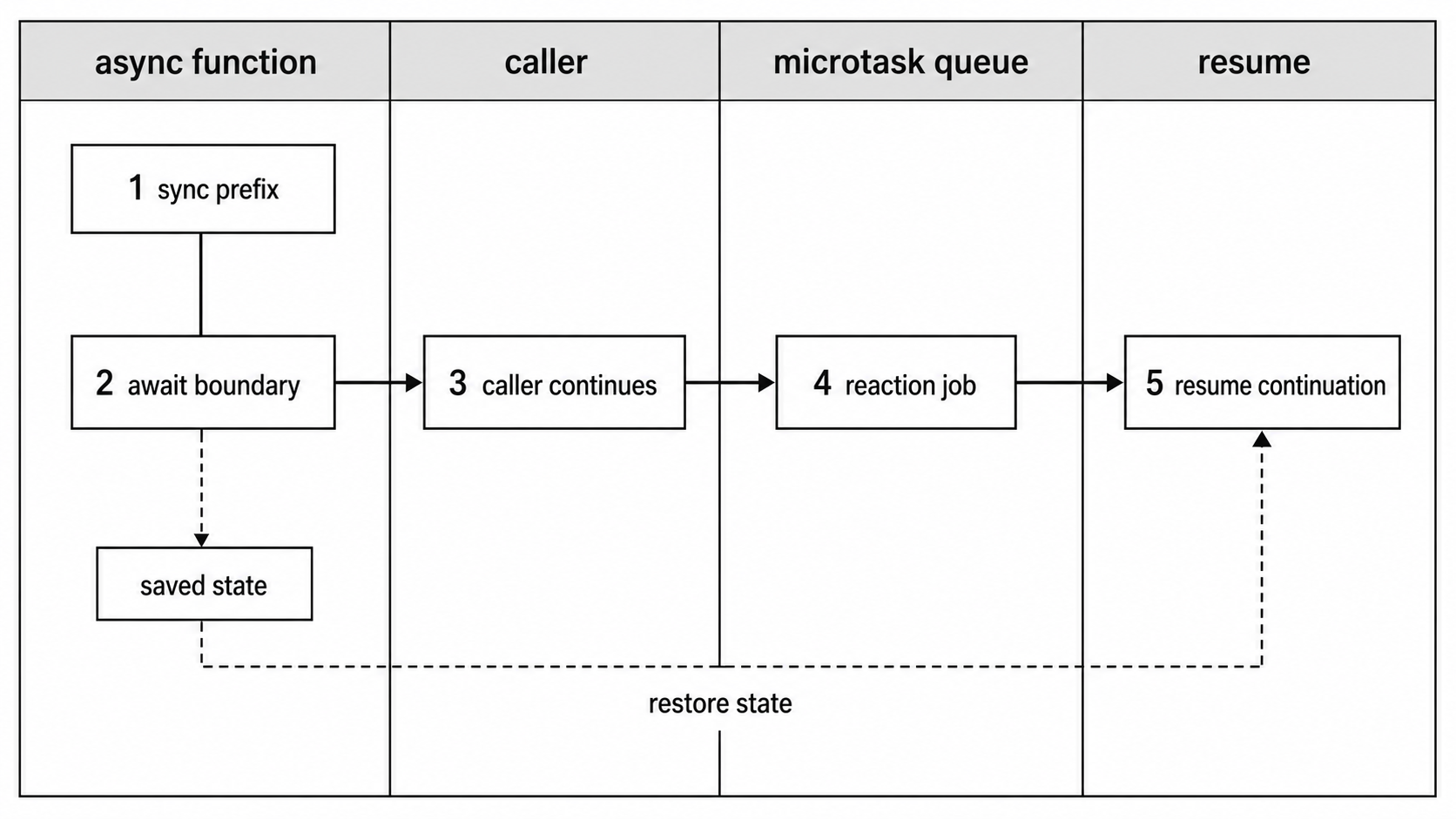
Figure 1 - An await point saves the current function state, returns control to the caller, and resumes the remaining body later as promise microtask work.
Everything before the first await is synchronous. The caller gets control back only when the async function reaches its first await, returns, or throws.
If the body has no await at all, the whole body runs before control returns to the caller. The result still comes through a promise -
async function noAwait() {
  console.log("sync");
  return "done";
}

noAwait();
console.log("after");
Output -
sync
after
A .then() attached to the returned promise still runs later as a microtask. Promise handlers keep their scheduling behavior even when the async function body finished synchronously.
Plain values also go through the await path -
async function waitValue() {
  const n = await 42;
  console.log(n);
}

waitValue();
V8 resolves the value, suspends the function, and later resumes it with 42. Generic code relies on that behavior when an input might be either a plain value or a promise. Writing await 42 by hand usually only adds a scheduling boundary.
The same boundary appears when the promise is already fulfilled. V8 has optimized the common native-promise path, but the basic behavior remains - code after await runs after the current synchronous stack has finished.
This also explains why sequential awaits create sequential work -
async function three() {
  const a = await step1();
  const b = await step2(a);
  return step3(b);
}
step2() starts only after step1() fulfills. step3() starts only after step2() fulfills.
That shape is correct when each step needs the previous result. It is slow when the operations are independent and could have started together.
The Promise-Chain Shape
Async/await reads from top to bottom, but each await still creates a continuation attached to a promise reaction.
async function fetchData(url) {
  const response = await fetch(url);
  const json = await response.json();
  return json;
}
You can think of it as the same continuation shape as this -
function fetchData(url) {
  return fetch(url)
    .then(response => response.json())
    .then(json => json);
}
The first await waits for fetch(url) to settle before running the response step. The second await waits for response.json() before returning the parsed value. The final return resolves the promise that fetchData() gave to its caller.
The error path follows the same idea -
async function fetchSafe(url) {
  try {
    const resp = await fetch(url);
    return await resp.json();
  } catch (e) {
    console.error("failed", e.message);
    return null;
  }
}
If either awaited operation rejects, the rejection is thrown at that await line. The catch block receives it like a normal exception.
That is the main reason async/await feels good to write. You get direct-style control flow while the promise machinery still handles scheduling underneath.
The other big win is local scope. In a .then() chain, each step runs in a separate function. Sharing state across steps usually means closures, wrapper objects, or extra function arguments. In an async function, the same local scope continues across await points.
That convenience has a memory cost. If a local variable points at a 50 MB buffer, and the function hits await db.save(), that buffer stays reachable while the database promise is pending. V8 has to keep the suspended function state alive so it can resume later. The locals that are still needed stay alive with it.
The generator connection is mostly history, but it helps explain older Node code. Before async/await landed in ES2017, many projects used generator functions with runner libraries. The runner called .next() after a yielded promise fulfilled and .throw() after rejection. Async functions turned that pattern into language syntax with promise integration built into the engine.
V8 still uses suspend-and-resume machinery that is related to generators. Promise resolution and the outer promise returned by an async function are the async-function-specific parts.
V8's State Machine
Every await is a place where V8 can stop the function and continue it later. That explains both the ordering you see and the cost model.
Keep one distinction in mind. The promise-returning behavior is JavaScript semantics. Internal object names and layouts are V8 implementation details. They are useful for understanding the model, but they can change between V8 releases.
When V8 compiles an async function, it emits bytecode that can suspend and resume. When the function is called, V8 creates the promise returned to the caller. It also creates internal async-function state so the function can be resumed after an awaited promise settles.
Current V8 source uses an internal object named JSAsyncFunctionObject. It extends the generator-object structure and includes a field for the outer promise. That object connects the returned promise, the saved execution state, and the function context needed to continue after an await.
The outer promise is created at function entry. It stays pending while the function runs, suspends, resumes, and possibly suspends again. If the function returns, V8 resolves that promise. If an error leaves the function unhandled, V8 rejects it. If the function has five awaits, the same outer promise remains the caller-facing result across all five suspension points.
The first part of the function runs like normal JavaScript. Locals live in the active stack frame while the function is running. At an await, V8 evaluates the expression, resolves it through the promise resolution rules, and attaches fulfillment and rejection reactions to the resulting promise.
Then V8 saves the current state - local variables, temporary values, and the bytecode position. The active stack frame can unwind. The saved state lives on the heap until the async function resumes.
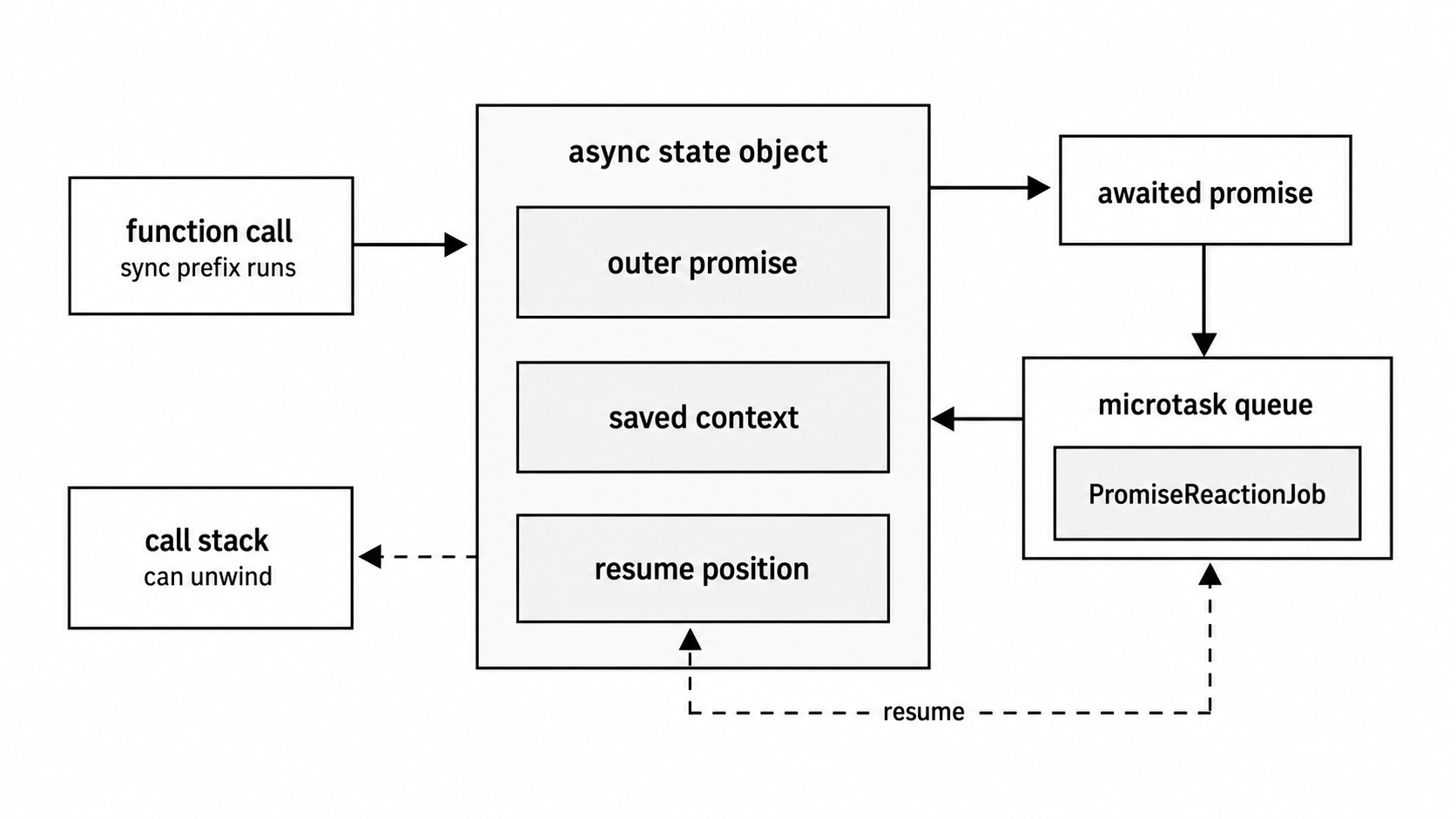
Figure 2 - V8 keeps the outer promise, saved execution context, awaited promise, and reaction job connected until the async function can resume.
When the awaited promise settles, V8 enqueues a PromiseReactionJob into its microtask queue. Node controls when V8 runs those jobs through embedder checkpoints, as covered in the previous subchapter.
At ordinary CommonJS and native-callback checkpoints, Node drains process.nextTick() first, then asks V8 to drain promise microtasks. Node's v24 process docs expose the same user-visible rule for queueMicrotask() and process.nextTick() - CommonJS drains nextTick first, while ES module top-level evaluation is already inside microtask processing and can order differently.
When the reaction job for the await runs, V8 restores the saved function state and continues right after the await expression.
Fulfillment resumes as a value. Rejection resumes as a throw. That is why normal try/catch works across an await point -
async function loadName(id) {
  try {
    const user = await fetchUser(id);
    return user.name;
  } catch (e) {
    return null;
  }
}
If fetchUser(id) rejects, V8 resumes the function at the await site by throwing the rejection reason. The function is still inside the original try region, so the catch block receives the error.
Older V8 versions paid more for each await. Before V8 7.2, awaiting an already-fulfilled native promise involved extra promise allocation and extra microtask turns. V8's fast-async work reduced the common native-promise path to one microtask turn. Node v24 has that optimized path, plus later work around promise resolution, async stack traces, and allocation.
The fast path applies to native promises from the current realm. Thenables take the full assimilation path. V8 has to read and call the .then property, and that property can run user code, throw, or resolve later. The engine has to follow the thenable protocol instead of treating it like a native promise.
The internal layout is useful to know, but do not build mental models that depend on exact field names. In current V8 source, JSAsyncFunctionObject extends JSGeneratorObject and adds the outer promise field. The generator part carries fields for the function, context, receiver, continuation, resume mode, and saved interpreter registers. Those names describe current implementation, not a public API.
Await resume handlers come from shared builtins around the await operation. Promise objects carry reaction lists. Microtask scheduling comes from promise reactions. Suspended execution state belongs to the async function object.
Allocation usually starts in the young generation of V8's heap. Short async functions often finish there and die cheaply. A function suspended on a slow network call may survive a young-generation collection and move to old generation.
The async-function object itself is usually small. The locals it keeps alive are the bigger concern. A suspended handler that still references a parsed request body, a large Buffer, and the request object can retain far more memory than the async machinery itself.
Async stack traces add another layer. A normal stack only shows the current synchronous call stack. Await points split execution across microtask turns, so V8 stores metadata that lets it reconstruct the chain of async calls.
When the chain crosses real await points, current Node.js releases can show frames like this -
Error: oops
    at innerFn (file.js:12:11)
    at async middleFn (file.js:8:20)
    at async outerFn (file.js:3:18)
The async frames show where the await chain passed through. Directly returning another promise can produce a shorter stack and omit intermediate async functions. That is one reason return await is still useful around error paths.
One low-level rule explains many ordering bugs. await resumes through a PromiseReactionJob, the same job type used by .then() handlers. Await continuations share ordering with .then() handlers and queueMicrotask().
Node's nextTick queue has priority at ordinary checkpoint edges, but it does not interrupt an active V8 microtask drain. That detail explains most "why did this log first" cases in async/await code.
Ordering Rules You Actually See
Code after await runs as a promise microtask.
console.log("1");

async function run() {
  console.log("2");
  await Promise.resolve();
  console.log("3");
}

run();
console.log("4");
Output -
1
2
4
3
Synchronous code runs first. The await continuation runs when the microtask queue drains.
When multiple async functions suspend, their continuations run in the order they enter the microtask queue -
async function a() {
  console.log("a1");
  await Promise.resolve();
  console.log("a2");
}

async function b() {
  console.log("b1");
  await Promise.resolve();
  console.log("b2");
}

a();
b();
Output -
a1
b1
a2
b2
Both synchronous prefixes run immediately. Then the await continuations drain in first-in, first-out order.
Extra awaits add extra continuation turns. If x() has two awaits and y() has one await, calling x(); y(); can interleave like this -
x1
y1
x2
y2
x3
x() resumes, prints x2, hits another await, and puts its next continuation at the back of the microtask queue. y() then gets to resume before x() continues again.
Node-specific ordering still applies, but top-level module context can change examples. In CommonJS, process.nextTick() runs before V8 promise microtasks at the checkpoint after the script returns -
// CommonJS, or node -e "..."
async function run() {
  await Promise.resolve();
  console.log("await");
}

run();
process.nextTick(() => console.log("nextTick"));
CommonJS output -
nextTick
await
The await queues a promise reaction. process.nextTick() queues into Node's separate nextTick queue. Node drains nextTick first, then V8's microtask queue.
In an ES module, top-level module evaluation is already inside microtask processing. Node's docs call out that the same top-level source prints this instead -
await
nextTick
Inside normal callbacks entered from libuv, the ordinary checkpoint rule still applies after the callback returns.
Node's current process docs mark process.nextTick() as legacy. Prefer queueMicrotask() unless you specifically need Node's nextTick priority or its argument-passing behavior.
Fire-and-forget code changes ordering for a simpler reason. The async function starts immediately, runs until its first await, and then the caller continues without waiting for completion -
async function save(data) {
  await db.insert(data);
  console.log("saved");
}

save(myData);
console.log("continuing");
continuing prints before saved. That may be what you want. If the returned promise is intentionally detached, attach a .catch() so failures do not disappear into an unhandled rejection.
Error Handling
Put try/catch around the awaits whose failures you can handle.
async function loadUser(id) {
  try {
    const user = await fetchUser(id);
    return user;
  } catch (e) {
    console.error("fetch failed", e.message);
    return null;
  }
}
If fetchUser(id) rejects, the await expression throws and the catch block receives the rejection reason. If nothing inside the async function handles it, the function's returned promise rejects.
async function loadUser(id) {
  const user = await fetchUser(id);
  return user;
}

loadUser(99).catch(e => console.error(e.message));
The rejection travels through returned promises until a caller handles it. Leave it unhandled and Node treats it as an unhandled rejection, covered in the previous subchapter.
Several awaits can share a catch block when the recovery is the same for all of them -
async function pipeline() {
  try {
    const raw = await fetchData();
    const parsed = await parseData(raw);
    return await saveData(parsed);
  } catch (e) {
    console.error("pipeline failed", e);
  }
}
That is clean when the whole pipeline has one failure response. If each step needs a different message, retry policy, or error wrapper, use smaller try/catch regions.
Here, only the fetch gets wrapped -
async function pipeline() {
  let raw;

  try {
    raw = await fetchData();
  } catch (e) {
    throw new Error("fetch failed", { cause: e });
  }

  return parseData(raw);
}
If parseData(raw) can fail and needs its own handling, give it a separate edge with its own message.
A common bug is creating a promise and then discarding it -
async function processJob() {
  doSomethingAsync();
  console.log("done");
}
doSomethingAsync() starts, but its returned promise goes nowhere. If it rejects, this function has no local error handling. Linters often call these floating promises. Treat them as defects unless fire-and-forget is intentional and has its own error path.
For intentional background work, attach a catch handler -
doSomethingAsync().catch(e => {
  console.error("background task failed", e);
});
return await is useful when the current function needs to catch a returned promise -
async function risky() {
  try {
    return await doSomethingAsync();
  } catch (e) {
    console.error("caught", e);
  }
}
With direct return, the try block only observes the synchronous call to doSomethingAsync(). A later rejection bypasses that local catch and goes to whoever awaits or catches the returned promise.
With return await, the function stays inside the try region until the promise settles. Use that form when you need local cleanup, error wrapping, logging, or better stack traces.
Direct return is good when the function only forwards a promise -
function getUser(id) {
  return db.query("SELECT * FROM users WHERE id = ?", [id]);
}
Use an async wrapper when you are adding transformation or local error handling -
async function getUser(id) {
  const row = await db.query("SELECT * FROM users WHERE id = ?", [id]);
  return normalizeUser(row);
}
Both functions return promises to the caller. The second version also creates async-function state. That cost is usually fine. In very hot library internals, measure before assuming.
finally works with awaited cleanup -
async function withLock(resource, fn) {
  await resource.lock();

  try {
    return await fn();
  } finally {
    await resource.unlock();
  }
}
If fn() rejects and unlock() rejects too, the finally rejection wins. That is the same rule as synchronous finally - a failure during cleanup replaces the earlier failure. Keep cleanup code small, tested, and noisy when it fails.
Cleanup often belongs in finally even when the protected operation returns a promise. return await fn() keeps the operation inside the try region until it settles. Direct return fn() can run cleanup before the returned promise has finished.
That behavior is important for locks, temporary files, spans, transactions, and file handles.
Patterns That Count
Sequential awaits are explicit, and sometimes they are exactly what you want.
for (const migration of migrations) {
  await runMigration(migration);
}
Database migrations, ordered writes, and rate-limited calls often need one operation to finish before the next starts.
Independent work should start together -
async function fetchAll(urls) {
  const responses = await Promise.all(
    urls.map(url => fetch(url))
  );

  return Promise.all(responses.map(r => r.json()));
}
Calling fetch(url) starts the work. await waits for the result. When operations are independent, collect the promises first and await them together.
That start-versus-wait distinction is easy to miss because await fetch(url) looks like one step. The function call starts the operation. The await observes its completion. Keeping those two ideas separate is how you avoid accidental sequential work.
Subchapter 06 covers promise combinators in detail, including failure behavior and bounded concurrency.
Array iteration methods deserve extra care with async callbacks -
urls.forEach(async (url) => {
  const res = await fetch(url);
  console.log(await res.text());
});

console.log("done");
forEach() ignores the promises returned by the async callback, so the final log runs immediately. Errors inside those callbacks become unhandled unless each callback catches its own failures.
filter(), some(), and every() do not await predicate promises either. Promise objects are truthy, so the result is usually wrong. sort() expects a numeric comparator result, not a promise.
Use for...of for sequential work -
for (const url of urls) {
  const res = await fetch(url);
  console.log(await res.text());
}
Use Promise.all(urls.map(...)) for concurrent work -
await Promise.all(
  urls.map(async (url) => {
    const res = await fetch(url);
    console.log(await res.text());
  })
);
Top-level await in ES modules makes async IIFEs less common, but CommonJS still uses the pattern -
(async () => {
  const config = await loadConfig();
  const server = await startServer(config);
  console.log("listening on", server.address().port);
})();
That pattern is fine in scripts and older CommonJS modules. In ESM on Node v24, module-scope await is available.
Avoid wrapping async code in a fresh Promise constructor -
async function getData(url) {
  return new Promise(async (resolve) => {
    const data = await fetch(url);
    resolve(data);
  });
}
The outer async function already returns a promise. The async executor creates another promise path and can lose rejections in ugly ways. Write the function directly -
async function getData(url) {
  return fetch(url);
}
Wrap callback APIs when the source is callback-based. Avoid wrapping promises with more promises.
An async Promise executor creates a broken edge. The executor passed to new Promise() is expected to call resolve or reject directly. Marking that executor async makes it return its own promise. If the executor throws after an await, that rejection belongs to the executor's promise, while the outer promise may stay pending depending on the code path.
That is the bad failure mode - a promise that never fulfills and never rejects.
Production Shape
In production Node v24 code, async/await should be the default shape for application logic. HTTP clients, database drivers, queues, test runners, and framework hooks mostly speak promises now.
Most performance problems are somewhere else. Network, disk, database, and timer latency usually dominate await continuation overhead. If profiling says async overhead is visible, look first for accidental sequential waits, huge fan-outs, missing batching, or missing concurrency limits.
Rewriting readable async/await code into raw .then() chains rarely helps outside library internals and tight loops.
await waits for a promise. It does not cancel the work behind that promise. Cancellation has to be part of the API you are calling, usually through an AbortSignal or a driver-specific cancellation handle.
Here is a timeout wrapper built around AbortController -
async function fetchJsonWithTimeout(url, ms) {
  const controller = new AbortController();
  const timer = setTimeout(() => controller.abort(), ms);

  try {
    const response = await fetch(url, { signal: controller.signal });
    return await response.json();
  } finally {
    clearTimeout(timer);
  }
}
The timeout aborts the request through the signal. The finally clears the timer whether the fetch succeeds, fails, or gets aborted.
Memory Around Await
Memory needs attention around await points. Every suspended async function can keep locals alive until it resumes. Keep scopes small around long waits, and drop large references when you are done with them.
async function handle(req) {
  let body = await readBody(req);
  const parsed = parseRequest(body);

  body = null;

  return db.save(parsed);
}
Setting body = null makes the intent clear. The raw payload is no longer needed before the database wait. V8 may still make its own optimization choices, but removing the reference gives the collector permission to reclaim it.
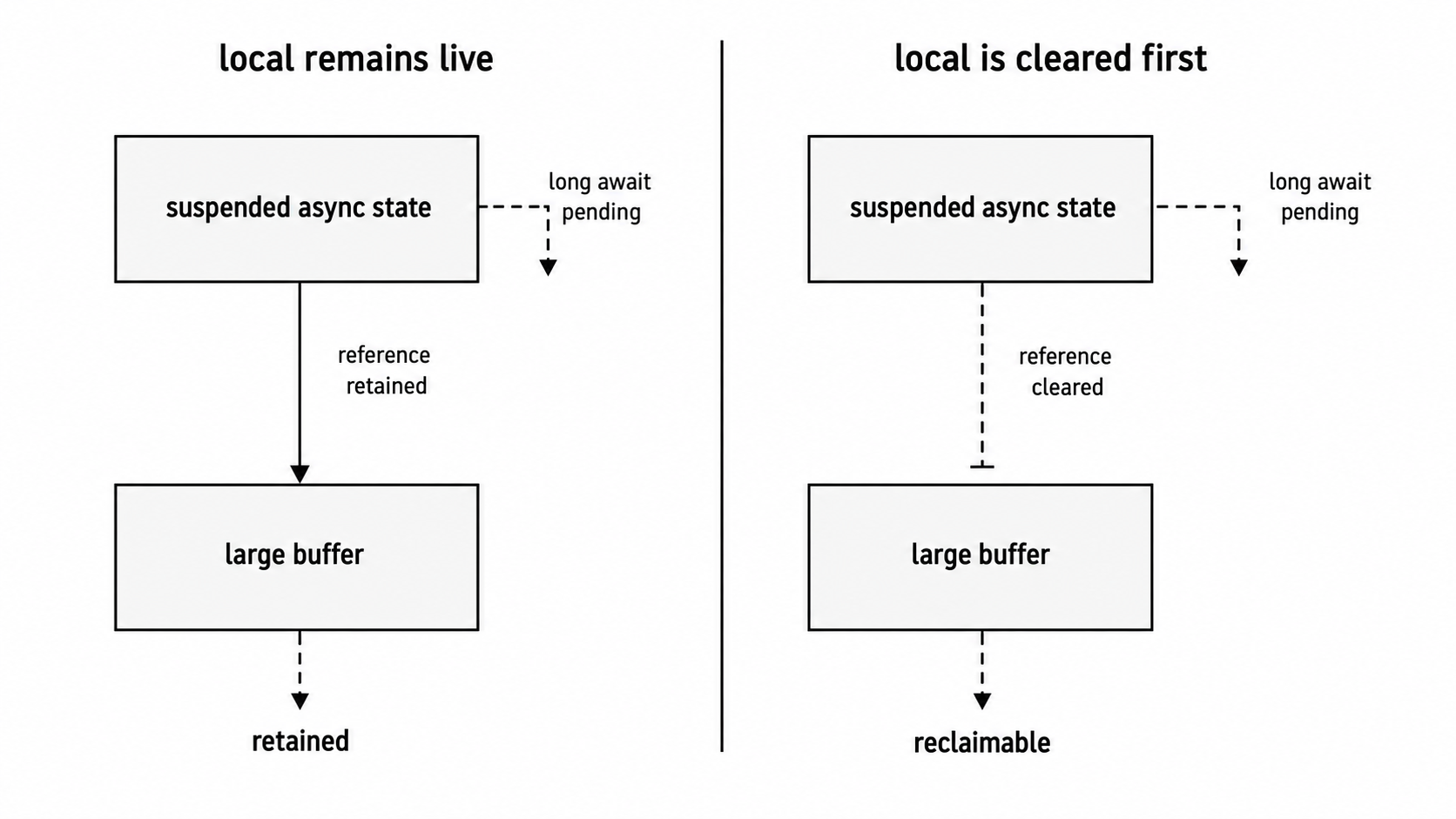
Figure 3 - Locals that remain reachable across an await stay alive with the suspended async-function state; clearing large references before a long wait can reduce retained memory.
Large fan-outs also need limits -
const results = await Promise.all(
  items.map(item => transform(item))
);
For 100 items, this is usually fine. For 100,000 items, it creates 100,000 promises and gives Promise.all() a huge set to track. If transform() is async and suspends, you also create a large number of suspended continuations.
The syntax is small, but the runtime work is large. The heap, database, remote API, thread pool, and downstream services all have limits.
Batch the work or use a concurrency limiter. A simple batch loop is boring and effective -
for (let i = 0; i < items.length; i += 100) {
  const batch = items.slice(i, i + 100);
  await Promise.all(batch.map(item => transform(item)));
}
That keeps only 100 transforms in flight at a time. The right number depends on the downstream system. Databases, queues, and APIs usually tell you through latency, errors, saturation, or rate-limit headers.
Production defaults -
- Use async/await for request handlers and business logic.
- Treat floating promises as bugs unless they have an explicit
.catch(). - Use
return awaitinsidetry/catchorfinally. - Return the promise directly when you are only forwarding it.
- Use
Promise.all()for independent work. - Add bounded concurrency for large batches.
- Pass cancellation signals or driver cancellation handles across long waits.
- Keep large buffers and parsed payloads out of scope before long awaits.
- Prefer
for...offor ordered async loops. - Avoid async callbacks with
forEach,filter,some,every, andsortunless the API explicitly consumes promises. - Profile before replacing async/await with
.then()for speed.
Cost Model
Each await usually involves a promise reaction, a microtask turn, and suspend/resume state for the async function. Node v24 makes this path cheap enough for normal application code, but the work still exists.
Raw .then() chains can win in some microbenchmarks because they avoid the async function object and some state restoration. The size and direction of that difference depends on the Node and V8 version, the function shape, and whether promise hooks, async hooks, or debugging are active.
Benchmark under the runtime you deploy before trading readable async/await code for hand-built chains.
The cost becomes visible in code that creates huge numbers of async function instances with tiny bodies -
const out = await Promise.all(
  items.map(async item => transformSyncPart(item))
);
If transformSyncPart() is effectively synchronous, the async callback adds promise and async-function allocation without adding useful scheduling. Use a synchronous map() for synchronous work. Keep async functions for work that crosses an async boundary.
The more common performance problem is accidental serialization -
for (const user of users) {
  await sendEmail(user);
}
This is correct for rate-limited or ordered sends. It is slow for independent sends. The syntax alone cannot tell you which one is intended. The data dependency tells you.
Debugging has improved enough that async/await is usually worth keeping. Async stack traces are enabled by default in current Node.js releases. The inspector can step across await points and show locals while a function is suspended.
That gives you readable source and useful stack traces, which is better than a hand-built promise chain for most application code.